Phosphating line
Used in defence, automotive, pre-paint and pre-rubber-bonding applications. Mostly zinc and manganese phosphate are applied. Final passivation is done with or without chromium.
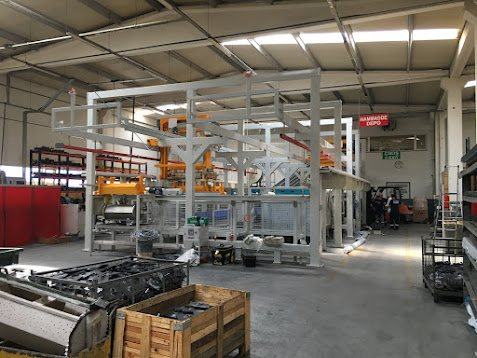
Process steps
- Degreasing
- Rinse
- Acid pickling
- Rinse
- Activation (surface conditioner)
- Manganese or zinc phosphate
- Rinse
- Passivation (chromium / chromium-free)
- Oiling or drying
Applications
- Defence industry parts
- Engine and gearbox parts (manganese phosphate)
- Preparation before painting and rubber bonding
- Bolts and fasteners
IPM Galvano scope
- Combining barrel, rack and basket on one line
- Compact U-shaped line layout
- Heating and desludging systems
- Fully automatic multi-robot operation
Lines we have built
| References | |||
|---|---|---|---|
| 2018 | Manganese phosphate line Sarsılmaz Silah Sanayi · Türkiye · Düzce | 1 lines · 1 robots · 14 stations | Manganese phosphate for friction reduction and corrosion resistance; process parameters monitored on a recipe-based automation screen. |
| 2017 | Phosphating line HD Kauçuk · Türkiye · Denizli | 1 lines · 2 robots · 22 stations | Fully automatic plant running both zinc and manganese phosphate on one line; surface preparation before rubber-to-metal bonding. |
Frequently asked questions
What does a turnkey phosphating line include?
Design, steel structure, polypropylene tanks, overhead transfer robots, rectifiers, filtration, extraction and scrubber, piping and PLC / SCADA automation are all ours. We install, commission and train operators on site, and design wastewater treatment together with our solution partners.
How long does it take to build a line?
The average project takes 4–12 months depending on scope. Duration depends mainly on the number of stations and robots, how ready the building is, and whether wastewater treatment is included.
What information do you need for a quote?
Part material and geometry, size and weight, annual volume or hourly capacity, required coating thickness and corrosion class, hall dimensions and available power / water supply. Part photos or drawings speed up the design.
Should I choose rack or barrel plating?
Small bulk parts (bolts, nuts, washers) are plated in barrels; large, heavy or surface-sensitive parts on racks. If your product mix varies, we also build flexible lines that run rack and barrel in the same station.
In which countries have you built lines?
Since 2017 we have built 37 lines in Türkiye, Germany, the Netherlands, Russia and Tajikistan. Besides our headquarters in Bursa we have an office in Solingen (Germany) and a representative office in Russia.
Do you provide support after commissioning?
Yes. We provide maintenance, spare parts, line extensions and upgrades, and can diagnose faults by connecting remotely to the automation system.
Get a quote for your project
Share your parts, capacity and hall dimensions and we will design the line together. One team handles design, manufacturing, installation and commissioning.
Request a quoteMessage us on WhatsAppExplore the line in 3D