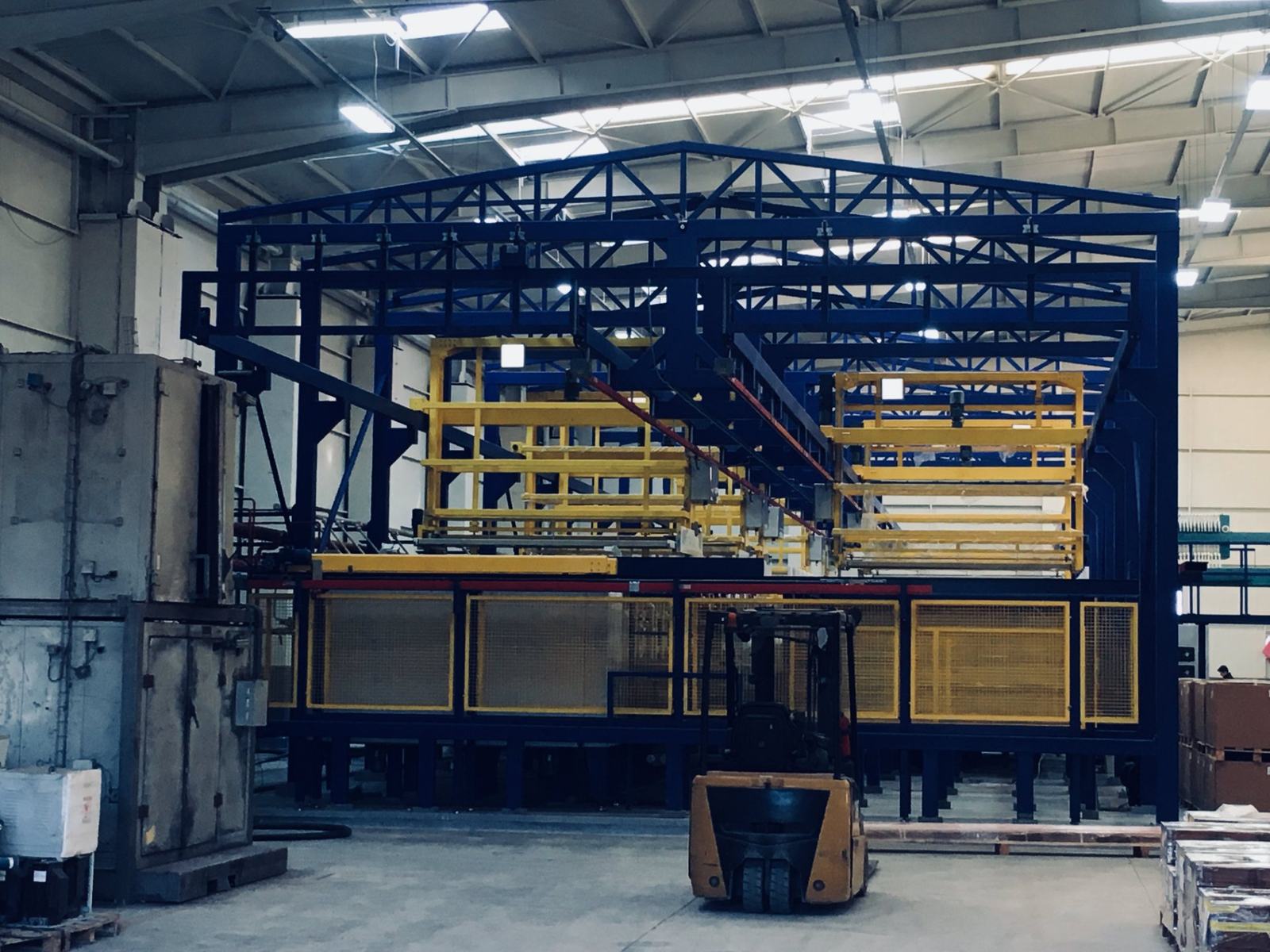
Turnkey nickel-chrome plating line
Combining a mirror finish with high corrosion resistance, it is the most widely chosen plating system in automotive, white goods, furniture and home decoration. We design the line around the part's base material (steel, brass, zamak), its geometry and the required corrosion class; for the top layer we also apply Cr³⁺ and dark chrome instead of Cr⁶⁺.
Process steps
- Chemical degreasing
- Electro-cleaning
- Acid activation
- Acid copper
- Semi-bright and bright nickel
- Microporous nickel
- Krom (Cr⁶⁺ / Cr³⁺, dark krom)
- Cascade rinsing and drying
Applications
- Automotive interior and exterior trim parts
- White goods and furniture fittings
- Bathroom fittings and home decoration
- Brass and zamak castings
IPM Galvano scope
- Rack or barrel line design
- Overhead transfer robots and line automation
- Rectifiers, heating–cooling and filtration
- Extraction and scrubber for chrome fumes
Lines we have built
| References | |||
|---|---|---|---|
| 2024 | Nickel / black Cr plating on stainless steel ACT Metal · Antec · Türkiye · Tekirdağ | 2 lines · 5 robots · 108 stations | Custom design with a 360° anode system. The rack rotates 360° for a uniform layer on complex geometries. |
| 2022 | Nickel / chrome plating line Hema Metal · Türkiye · İnegöl | 2 lines · 4 robots · 75 stations | Decorative nickel-chrome plant; two synchronised lines give high capacity and uninterrupted production. |
| 2019 | Nickel / chrome plating line Autoliv · Türkiye · Gebze | 2 lines · 9 robots · 99 stations | Two-line plant for automotive safety components; high robot count, synchronised transfer algorithm and OEM quality requirements. |
| 2018 | Nickel / chrome plating line Bulut Metal · BMK · Türkiye · Gebze | 2 lines · 7 robots · 94 stations | High station-count rack line for decorative nickel-chrome; turnkey including tanks, robots, extraction and walkways. |
Frequently asked questions
What does a turnkey nickel-chrome plating line include?
Design, steel structure, polypropylene tanks, overhead transfer robots, rectifiers, filtration, extraction and scrubber, piping and PLC / SCADA automation are all ours. We install, commission and train operators on site, and design wastewater treatment together with our solution partners.
How long does it take to build a line?
The average project takes 4–12 months depending on scope. Duration depends mainly on the number of stations and robots, how ready the building is, and whether wastewater treatment is included.
What information do you need for a quote?
Part material and geometry, size and weight, annual volume or hourly capacity, required coating thickness and corrosion class, hall dimensions and available power / water supply. Part photos or drawings speed up the design.
Should I choose rack or barrel plating?
Small bulk parts (bolts, nuts, washers) are plated in barrels; large, heavy or surface-sensitive parts on racks. If your product mix varies, we also build flexible lines that run rack and barrel in the same station.
In which countries have you built lines?
Since 2017 we have built 37 lines in Türkiye, Germany, the Netherlands, Russia and Tajikistan. Besides our headquarters in Bursa we have an office in Solingen (Germany) and a representative office in Russia.
Do you provide support after commissioning?
Yes. We provide maintenance, spare parts, line extensions and upgrades, and can diagnose faults by connecting remotely to the automation system.
Get a quote for your project
Share your parts, capacity and hall dimensions and we will design the line together. One team handles design, manufacturing, installation and commissioning.
Request a quoteMessage us on WhatsAppExplore the line in 3D